

Do you think that a solar inverter only converts electricity from one form to another? We’d say, think again! The capacity of a solar inverter determines how much solar power your home can use at a given time, while its design influences grid interaction, battery backup, and the appliances you can operate. And for many 1-2 BHK Indian homes, a 3 kVA solar inverter is the most practical capacity.
Modern 3 kVA inverters with a power factor of 1.0 provide up to 3,000 watts of usable power. This makes them suitable for common household loads such as lights, fans, a refrigerator, a television, a Wi-Fi router, and even an AC when the combined running and starting loads remain within the inverter’s limits.
Choosing a 3 kVA inverter model, however, requires more than checking its capacity on the label. You need to understand the inverter type, MPPT (maximum power point tracking) technology, PV (photovoltaic) input limits, battery requirements, surge capacity, and actual price before making a decision.
This guide explains the 3 kVA solar inverter load capacity, specifications, types, battery and panel requirements, and factors to check before choosing one for your home. You’ll also discover the 3 KVA solar inverter price in India in 2026.
What is a 3 KVA Solar Inverter?
A 3 kVA inverter is a power conversion device designed to handle an apparent power capacity of 3 kilovolt-amperes. It converts the direct current (DC) electricity produced by solar panels into alternating current (AC) that household appliances can use.
Depending on the inverter type, it may also manage electricity flowing to or from the grid, control battery charging, supply backup power during outages, and monitor the overall flow of electricity.
The 3 kVA rating tells you the inverter’s power-handling capacity. Understanding what that means in watts makes the rating much easier to use when planning household electrical loads.
3 kVA vs 3 kW: What Is the Difference?
While kVA (kilovolt-ampere) measures apparent power and kW (kilowatt) measures actual working power, modern solar inverters have a Power Factor (PF) of 1.0. This creates a 1:1 relationship between kVA and kW.
The calculation is: Power (kW) = Apparent Power (kVA) × Power Factor
Hence, for a 3 kVA inverter: 3 kVA × 1.0 = 3 kW
The distinction still matters because kVA indicates the inverter’s apparent power rating, whereas kW indicates the real power available to your appliances.
How Many Watts Is a 3 kVA Solar Inverter?
As listed above, a modern 3 kVA solar inverter with a PF of 1 delivers the full 3 kW. Since 1 kW equals 1,000 W, 3 kW = 3,000 W.
Therefore, a modern 3 kVA solar inverter provides 3,000 watts of actual power capacity.
How Does a 3 kVA Solar Inverter Work?
A 3 kVA solar inverter continuously manages electricity as solar generation and household demand change throughout the day. Exactly where the excess power comes from depends on whether you install an on-grid, off-grid, or hybrid inverter.
The basic working process involves three important functions:
- DC to AC conversion: Solar panels produce DC (direct current) electricity. The inverter converts this to 230V single-phase AC (alternating current) electricity for home appliances.
- Power management: It prioritizes solar electricity for running loads. If solar power is insufficient, it intelligently blends or draws power from the grid or battery bank, depending on its configuration.
- Battery charging: In hybrid and off-grid solar systems, it regulates incoming solar power to safely charge attached battery energy storage systems.
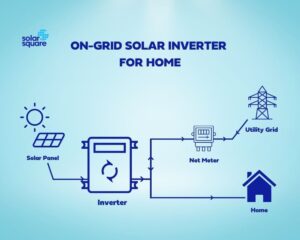
An on-grid solar inverter sends excess solar electricity to the grid, while an off-grid solar inverter stores available energy in batteries. A hybrid inverter can combine solar, battery, and grid power according to its operating mode and configuration.
How Much Load Can a 3 kVA Solar Inverter Handle?
The 3 kVA solar inverter load capacity is one of the most important considerations when deciding if this inverter size suits your home. A 3 kVA unit can supply up to 3,000 W from the inverter, but the practical meaning of that limit varies by system type.
Here is how the load behaves in different configurations:
- On-grid inverter: Your total connected household load does not have a functional 3,000 W ceiling simply because the solar inverter is rated at 3 kVA. The inverter can deliver up to 3,000 W of solar power, while the grid supplies additional electricity when household consumption exceeds the inverter’s output.
- Off-grid inverter: When the inverter and batteries are the only available power source, your continuous connected load must remain within the inverter’s 3,000 W limit.
- Hybrid inverter in backup mode: During a power cut, the inverter operates from the available battery and solar supply. The backup load must therefore remain within its 3,000 W continuous output capacity.
Appliances You Can Run on a 3 kVA Solar Inverter
A 3 kVA inverter is optimal for a 1 BHK or 2 BHK home. It can support multiple everyday appliances when you properly manage the combined load. The exact consumption of an appliance varies by model, efficiency rating, age, and operating mode. Therefore, appliance nameplates should always take priority over generic estimates.
That said, a 3 KVA inverter can run:
- 1 AC of around 1 ton or 1.5 ton
- 1 refrigerator
- 1 television
- Several LED lights
- Multiple ceiling fans
- Wi-Fi router
- Laptop and mobile chargers
Continuous Load vs Starting/Surge Load
An appliance does not always consume the same amount of electricity from the moment you switch it on. Devices with motors and compressors require a brief burst of additional power at startup.
A 3 kVA inverter therefore has to deal with two different load values:
- Continuous load: The running wattage that appliances pull constantly (must stay under 3,000 W total).
- Starting/surge load: Motorized appliances (such as AC compressors and refrigerators) draw higher power at startup. A standard 3 kVA inverter can handle 1.2× to 1.5× its rated capacity (3,600 W to 4,500 W) for a brief duration of 5 to 10 seconds to accommodate starting surges.
What are the Different Types of a 3 KVA Solar Inverter?
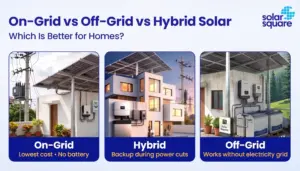
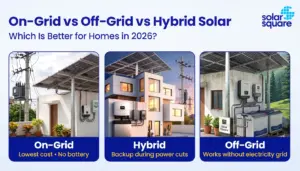
A 3 kVA inverter generally falls into one of three categories based on its relationship with the grid and battery storage.
- 3 KVA on-grid solar inverter: It’s tied directly to the electricity grid without batteries and exports excess solar energy to the grid via solar net metering. It does not provide backup during grid power outages due to the anti-islanding feature.
- 3 KVA off-grid solar inverter: An off-grid solar inverter works independently of the utility grid and uses a battery bank to store electricity for later use. It is ideal for regions with frequent power failures or zero grid access.
- 3 KVA hybrid solar inverter: It combines the features of both on-grid and off-grid systems. It exports excess power to the grid, uses battery backup during power cuts, and allows charging from both solar panels and the grid.
On-Grid vs Off-Grid vs Hybrid 3 kVA Inverter: Which Should You Choose?
All three inverter types can carry the same 3 kVA capacity label while serving very different household requirements. Your choice should therefore start with how you want to use solar power rather than the capacity number alone.
The following comparison makes the key differences easier to see:
| Factor | 3 kVA On-Grid Inverter | 3 kVA Off-Grid Inverter | 3 kVA Hybrid Inverter |
| Utility grid connection | Required | Not required | Supported |
| Battery required | No | Yes | Yes |
| Backup during grid outage | No | Not applicable | Yes |
| Excess grid export | Yes | No | Yes, if the DISCOM allows net metering |
| Initial cost | Low | Moderate | High |
| Best suited for | Homes with a stable grid supply and infrequent power cuts | Homes in remote and rural areas with no grid supply | Homes in areas with an unpredictable grid with frequent and prolonged power cuts |
Important 3 kVA Solar Inverter Specifications
The following 3 kVA solar inverter specification table shows indicative details for an on-grid configuration:
| Specification | Explanation |
| Maximum PV input power | 4.5 kWp |
| Maximum DC input voltage | 550/600V |
| MPPT voltage range | 150-480V |
| Number of MPPTs | 1 |
| Maximum input current per MPPT | 20amp |
| Grid frequency | 50 Hz |
| Maximum efficiency | 97.1% |
| Operating temperature | -25°C to +60°C |
| Anti-islanding | Yes |
| Communication | Wi-Fi/GSM/app monitoring |
| Warranty | ~8 years |
| Applicable standards | BIS/grid-specific requirements |
Please note: The specifications above are indicative examples for a 3 kVA on-grid solar inverter and should not be treated as standard specifications for every 3 kVA model. Actual values can vary by inverter brand and model, product series, single-phase or three-phase configuration, maximum supported PV capacity, DC voltage and current limits, number and range of MPPTs, efficiency, protection rating, operating temperature range, cooling design, communication and monitoring features, built-in safety protections, warranty terms, and applicable BIS (Bureau of Indian Standards) compliance, DISCOM, or other grid-compliance requirements. Manufacturers may also revise product specifications over time. Always check the latest datasheet for the exact inverter model proposed for your solar installation.
MPPT vs PWM: What Does It Mean in a 3 kVA Solar Inverter?
MPPT and PWM describe how solar charging electronics manage the power coming from the panels. They are not separate categories like on-grid, off-grid, and hybrid.
- PWM (Pulse Width Modulation): This is an older solar charge controller technology that clamps the panel voltage to the battery voltage, resulting in power loss. PWM is obsolete in India now.
- MPPT (Maximum Power Point Tracking): It is the modern standard technology. MPPT dynamically tracks the panel voltage to yield 5% to 10% higher overall energy output (and up to 10% to 12% higher instantaneous efficiency) compared to PWM.
How Many Batteries Does a 3 kVA Off-Grid or Hybrid Solar Inverter Need?
The number of batteries required for a 3 kVA solar inverter depends on the inverter’s DC operating voltage (24V or 48V) and the battery technology used (lithium-ion or lead-acid).
For a 3 kVA home solar system, a storage capacity of 2.5 kWh to 5 kWh is recommended.
For common 24V and 48V configurations, the battery arrangements can look like this:
| Type of Battery | 24V Inverter Systems | 48V Inverter Systems |
| Lithium (LFP) |
| Requires 1 battery pack if using a single 48V (51.2V nominal) 100Ah lithium wall-mounted module (~5.1 kWh total storage). |
| Lead-acid | Requires 2 x 12V batteries connected in series to match the 24V DC bus voltage (e.g., two 100Ah or 200Ah 12V lead-acid batteries). | Requires 4 x 12V batteries connected in series to reach the required 48V system input. |
Higher-voltage configurations, such as 48V, are preferred for 3 kVA systems because operating at higher voltages reduces current, lowering heat generation and cable losses throughout the installation.
How to Estimate Battery Backup Time?
Battery backup depends on total voltage, Ah capacity, usable depth of discharge (DoD), inverter efficiency, and connected appliance load.
For the lithium iron phosphate (LFP) battery examples below, we’ve used an 85% usable depth of discharge and 90% round-trip efficiency.
The calculation is done using this formula: Backup time (hours) = (Battery nominal voltage × Battery Ah × Usable DoD × round-trip efficiency) ÷ Appliance load in watts.
Let’s look at the following two examples that showcase how household load affects backup time.
#1. Example with a 24V System
Assume a 25.2V nominal, 100Ah LFP battery.
- Usable AC Energy = 25.2V × 100Ah × 0.85 × 0.90 = 1,927.8 Wh, or approximately 1.93 kWh
- Battery backup time for a 100 W load: 1,927.8 Wh ÷ 100W = 19.28 hours
- Battery backup time for a 300 W load: 1,927.8 Wh ÷ 300W = 6.43 hours
#2. Example with a 48V System
Assume a 51.2V nominal, 100Ah LFP battery:
- Usable AC Energy = 51.2V × 100Ah × 0.85 × 0.90 = 3,916.8 Wh, or approximately 3.92 kWh
- Battery backup time for a 300 W load: 3,916.8 Wh ÷ 300W = 13.05 hours
- Battery backup time for a 1,000 W load: 3,916.8 Wh ÷ 1,000W = 3.92 hours
These calculations show why backup hours should always be discussed together with the connected load. A battery that lasts most of the day with lights and fans can discharge much faster when an AC, pump, or another high-power appliance runs.
How Many Solar Panels Can You Connect to a 3 kVA Solar Inverter?
A 3 kVA solar inverter can handle around 3,000 W to 3,600 W (3 kW to 3.6 kW) of solar-panel capacity.
For example, using modern high-wattage modules:
- 5 × 600W panels = 3,000 W
- 5 × 610W panels = 3,050 W
- 7 × 540W panels = 3,780 W
- 7 × 550W panels = 3,850 W
Panel wattage alone, however, cannot determine the final string arrangement. Your installer must keep the solar array within the inverter’s permitted maximum PV power, MPPT voltage range, maximum DC voltage, and input-current limits.
For an indicative unit with an MPPT range of 150V to 480V and a maximum DC input of 550V or 600V, the installer must calculate the panel Voc and operating voltage before deciding how many modules to place in each series string.
What’s the 3 kVA Solar Inverter Price in India in 2026?
The 3 kVA solar inverter price varies considerably because an on-grid inverter, an off-grid solar PCU, and a battery-ready hybrid unit perform different functions.
In 2026, the approximate ranges work out as follows:
- 3 kVA on-grid solar inverter price*: ~₹6 to ~₹8 per watt
- 3 kVA off-grid solar inverter price**: ~₹10 to ~₹12 per watt
- 3 kVA hybrid solar inverter price**: ~₹16 to ~₹20 per watt
*Please note: The per-watt on-grid 3 KVA solar inverter price listed above is an indicative range and should not be treated as a final quotation. The actual price can vary based on the inverter’s capacity, type, single-phase or three-phase configuration, brand and model, number of MPPTs, efficiency, DC input and overloading capability, monitoring and communication features, IP rating, warranty and extended warranty options, applicable safety and grid-compliance requirements, after-sales service coverage, GST, dealer or distributor margins, location, product availability, ongoing discounts or offers, protection devices, communication dongles, installation, or commissioning charges.
**Please note: The per-watt off-grid and hybrid 3 KVA inverter prices in India listed above are indicative ranges and should not be treated as final quotations. The actual price can vary based on the inverter’s capacity, brand and model, number of MPPTs, efficiency, IP rating, battery type and capacity, warranty and extended warranty options, after-sales service coverage, GST, dealer or distributor margins, location, product availability, ongoing discounts or offers, protection devices, communication dongles, installation, or commissioning charges.
What Affects the Price of a 3 kVA Solar Inverter?
Capacity is only one factor behind the final price. Two 3 kVA solar inverters can sit in very different price brackets because their internal hardware, control functions, and protection features differ.
Important price factors include:
- Inverter type: Hybrid models cost more than conventional on-grid or off-grid inverters.
- MPPT technology: The number of MPPTs and supported voltage windows can affect hardware complexity.
- PV input capacity: Models that accommodate larger arrays or wider input ranges may cost more.
- Battery compatibility: Support for LFP batteries and battery management system communication can increase the price.
- Surge capability: Higher short-duration output can be valuable where pumps, compressors, or ACs are used.
- Monitoring: Wi-Fi, GSM, mobile apps, and remote diagnostics can add to product cost.
- Protection systems: Anti-islanding, surge protection, over-voltage, short-circuit, and temperature protection contribute to product design.
- Build quality and ingress protection: Equipment designed for demanding installation conditions may cost more.
- Warranty: Longer standard or extended warranty coverage can influence pricing.
- Brand and service support: A strong installation and after-sales network can also affect the selling price.
Pros and Cons of a 3 KVA Solar Inverter
A 3 kVA inverter can provide a useful balance between power capacity, equipment size, and cost for a moderate household load. Yet it works well only when it matches your current and projected electricity needs.
Here’s a snapshot of the main benefits and drawbacks of a 3 KVA solar inverter:
| Advantages of a 3 KVA Inverter | Disadvantages of a 3 KVA Inverter |
| When it has a power factor of 1, it provides up to 3,000 W of usable power | May be insufficient for several heavy appliances running together |
| Suitable for 1 BHK and 2 BHK load profiles | Off-grid backup is limited by battery capacity |
| MPPT models improve solar energy capture compared with PWM | Hybrid models cost significantly more than on-grid and off-grid inverters |
| Compact capacity for common residential applications | You cannot choose panel strings based on wattage alone |
How to Choose the Right 3 kVA Solar Inverter for Your Home?
A good buying decision begins with your household load, not a brand name or an advertised feature. Calculate what you actually need first. Then, compare inverters that meet those requirements.
Use the following checks before selecting a model:
- Calculate your simultaneous load: Add the wattage of appliances you expect to operate together.
- Identify surge-heavy appliances: AC compressors, refrigerators, and water pumps require additional starting power.
- Decide whether you need backup: Choose on-grid if grid-connected solar savings are your main goal, off-grid for independent, battery-backed operation, or hybrid if you want grid interaction plus storage.
- Confirm the 3,000 W capacity: Make sure your planned off-grid or backup load remains below the inverter’s continuous output.
- Check the surge rating: Verify that the manufacturer’s short-duration capacity is sufficient for your motor-driven appliances.
- Check PV input specifications: Match the solar array to the MPPT voltage range, maximum PV power, DC voltage, and input current limits.
- Compare warranty and service: Easy access to technical support becomes important if the inverter requires diagnosis or replacement years after installation.
A professional load assessment can prevent both undersizing and unnecessary oversizing. If you are unsure whether a 3 kVA solar inverter meets your home’s actual load and solar requirements, book a free solar consultation call with Shree Rudra Power Systems to receive a system recommendation tailored to your electricity use and backup needs.
Frequently Asked Questions
Can a 3 kVA solar inverter run a 1-ton AC?
Yes. A 3 kVA solar inverter can run a 1-ton AC when the AC’s running and starting requirements, together with the other connected appliances, remain within the inverter’s continuous and surge limits.
Does a 3 kVA on-grid solar inverter work during a power cut?
No. A 3 kVA on-grid solar inverter shuts down when the utility grid fails, even if the panels are producing electricity. This is known as anti-islanding protection, which prevents the inverter from energizing utility lines while repair personnel are working on them.
Can a 3 kVA inverter run a refrigerator and AC together?
Yes, provided their combined continuous load and the starting surge remain within the inverter’s limits.
A refrigerator and AC both contain compressors. So, startup demand deserves particular attention. A 3 kVA inverter provides 3,000 W of continuous capacity and can handle a brief surge of ~3,600 W to ~4,500 W for 5 to 10 seconds.
What battery voltage does a 3 kVA solar inverter use?
A 3 kVA off-grid or hybrid inverter can use battery configurations such as 24V, 36V or 48V, depending on the model. For example, a 24V-class system can use a 25.2V nominal LFP pack, while a 48V-class system can use a 51.2V nominal LFP battery.
Is MPPT better than PWM for a 3 kVA solar inverter?
Yes, compared with PWM, MPPT can deliver around 5% to 10% greater overall energy yield and up to approximately 10% to 12% greater instantaneous efficiency.
Can a 3 kVA solar inverter work without a battery?
It depends on the inverter type. A 3 kVA on-grid inverter operates without a battery because it connects to the utility grid. Hybrid and off-grid inverters, on the other hand, use batteries.
What is the lifespan of a 3 kVA solar inverter?
A tier-1 string solar inverter can last for ~8 years, although heat, installation quality, electrical conditions, maintenance, and product design can affect actual service life.
What warranty should I look for on a 3 kVA solar inverter?
Look for a warranty of ~8 years for string inverters. For microinverters, which are extremely expensive, a ~25-year warranty can complement their long lifespan.
Is a 3 kVA solar inverter enough for your home?
A 3 kVA solar inverter is sufficient for most 1 BHK and 2 BHK homes looking to offset electricity bills and power standard household loads, including one AC, a refrigerator, a TV, lights, and fans.