A 4-5 BHK bungalow or a large villa with multiple air conditioners and an EV (electric vehicle) has very different power requirements from those of a smaller Indian home. In such high-consumption homes, a 10 kVA solar inverter can provide the capacity needed to handle larger simultaneous loads and a bigger solar array.
In 2026, the indicative 10 kVA solar inverter price ranges from approximately ₹8* to ₹18* per watt, depending primarily on the inverter type.
*Please note: The per-watt 10 KVA solar inverter price range listed above is an indicative range and should not be treated as a final quotation. The actual price can vary based on the inverter type, single-phase or three-phase configuration, brand and model, number of MPPTs (Maximum Power Point Tracker), efficiency, DC input and overloading capability, monitoring and communication features, IP (ingress protection) rating, warranty and extended warranty options, applicable safety and grid-compliance requirements, after-sales service coverage, GST, dealer or distributor margins, location, product availability, ongoing discounts or offers, protection devices, communication dongles, installation, or commissioning charges.
For a modern inverter operating at a power factor of 1, 10 kVA corresponds to 10 kW (10,000 W) of real power. However, inverter capacity alone doesn’t determine whether it is right for your property. Your appliance load, grid reliability, battery requirement, available roof area, and electricity consumption matter, too.
This guide explains the 10 kVA solar inverter price in India, its load capacity, types, specifications, battery backup, panel compatibility, and factors to consider when choosing one in 2026.
What is a 10 kVA Solar Inverter?
A 10 kVA solar inverter is a device that converts DC (direct current) electricity generated by solar panels into AC (alternating current) electricity and can handle an apparent power capacity of 10 kilovolt-amperes. In modern solar inverters with a power factor of 1, this corresponds to up to 10 kW or 10,000 W of real power.
The calculation can be done using the formula listed below:
Power in kW = Apparent power in kVA × Power factor
For a 10 kVA inverter with a power factor of 1, 10 kVA × 1 = 10 kW = 10,000 W
The exact role of the inverter then depends on whether you choose an on-grid, off-grid, or hybrid model. It may interact with the electricity grid, charge batteries, provide backup power, or perform a combination of these functions.
How Much Load Can a 10 kVA Solar Inverter Handle?
A modern 10 kVA solar inverter can provide up to 10,000 W of real power when it operates at a power factor of 1. However, how this 10,000 W limit affects your home depends on the inverter type.
- On-grid inverter: The 10 kVA rating of an on-grid solar inverter limits the amount of solar power it can convert and supply. Your house is not limited to a total load of 10,000 W because the electricity grid can supply additional power when consumption exceeds available solar generation via solar net metering.
- Off-grid inverter: If solar and batteries are your only power sources, the simultaneous continuous load must remain within the rated real power output of the off-grid solar inverter.
- Hybrid inverter during a grid outage: Appliances connected to the backup circuit must remain within the specified backup output and battery limits of the hybrid solar inverter.
Starting load also matters in battery-backed rooftop solar systems. AC compressors, pumps, refrigerators, and other motor-driven appliances can briefly draw more power while starting. The actual short-duration surge capability should therefore always be checked on the inverter datasheet.
What Appliances Can a 10 kVA Solar Inverter Run?
A 10 kVA solar inverter can power multiple high-power household appliances simultaneously, making it suitable for large 4-5 BHK villas and bungalows with several ACs and even an EV.
A possible household load for a 10 kVA solar inverter could include:
Appliance | Quantity |
1.5-ton AC | 2 |
1-ton AC | 2 |
Refrigerator | 1 |
Ceiling fans | 8 |
LED lights | 15-20 |
Televisions | 2-3 |
Wi-Fi router, laptops, and chargers | Multiple |
Please note: The actual number of appliances and their load consumption can vary considerably depending on appliance model, star rating, inverter technology, age, and operating conditions. Always use the appliance nameplate or manufacturer data when calculating the final electrical load.
How Does a 10 kVA Solar Inverter Work?
A 10 kVA solar inverter converts the DC electricity produced by a large solar array into AC electricity while managing up to its rated power capacity. What happens to excess or insufficient solar power depends on whether the system is on-grid, off-grid, or hybrid.
The basic process works as follows:
- Solar panels generate DC electricity: Sunlight falling on the PV modules produces direct current electricity.
- MPPT tracks the available solar power: The MPPT (maximum power point tracking) inverter continuously adjusts the operating point of the solar array to extract power efficiently as sunlight and module temperature change.
- The inverter converts DC into AC: The incoming DC electricity is converted into AC electricity suitable for the home’s electrical loads.
- The inverter manages differences between generation and demand: A rooftop on-grid solar system can import or export electricity through the utility grid connection. An off-grid solar system relies on its batteries when solar production falls short. A hybrid solar power system can coordinate solar, batteries, and the electricity grid.
- Battery charging occurs where applicable: Off-grid and hybrid models use compatible charging electronics to replenish the attached battery bank when sufficient solar or grid power is available.
The 10 kVA rating determines the inverter’s power handling capacity. It does not, by itself, determine the amount of solar energy produced each day or how long a battery will provide backup.
What are the Different Types of 10 kVA Solar Inverters?
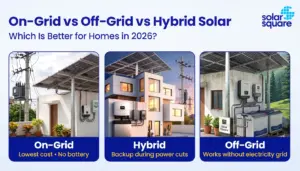
A 10 kVA solar inverter can be on-grid, off-grid, or hybrid. The right type depends mainly on whether you need battery backup and how reliable the electricity grid is at your property.
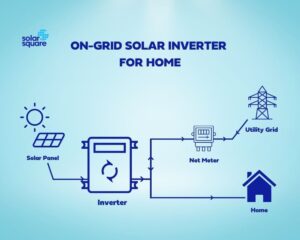
- 10 kVA on-grid solar inverter: It works with the utility grid and does not require batteries. Solar power helps meet your electricity demand, and excess generation can be exported to the grid through net metering. It shuts down during a grid outage due to anti-islanding protection.
- 10 kVA off-grid solar inverter: It works independently of the electricity grid and uses solar rechargeable batteries to store solar energy for use when generation falls or stops.
- 10 kVA hybrid solar inverter: It works with solar panels, battery storage, and the electricity grid. Depending on the configuration, it can reduce grid consumption while also providing battery backup during outages.
On-Grid vs Off-Grid vs Hybrid 10 kVA Inverter
A 10 kVA on-grid inverter uses the utility grid without batteries. An off-grid inverter, on the other hand, relies on solar and batteries without grid support. And a hybrid inverter combines solar, a battery energy storage system, and grid connectivity for both savings and backup power.
Here is how the three options differ in practical use:
Factor | 10 kVA On-Grid Inverter | 10 kVA Off-Grid Inverter | 10 kVA Hybrid Inverter |
Grid connection | Required | Not required | Supported |
Battery required | No | Yes | Yes |
Backup during grid outage | No | Power outage is not applicable in off-grid setups | Yes |
Grid export | Yes | No | Possible, depending on configuration and DISCOM rules |
Initial investment | Lowest | Higher | Highest |
Primary objective | Electricity bill savings | Grid independence | Savings plus backup |
Best suited for | Properties with reliable grid power | Remote locations without grid access | Properties with grid access but frequent outages |
What’s the 10 kVA Solar Inverter Price in India in 2026?
The actual cost of a 10 KVA solar inverter can vary significantly depending on factors such as the brand and type of inverter.
Here’s a ballpark range that gives you an approximate idea of the 10 KVA solar inverter price in India in 2026:
- 10 kVA on-grid solar inverter price*: ~₹8 to ~₹10 per watt
- 10 kVA off-grid solar inverter price*: ~₹10 to ~₹12 per watt
- 10 kVA hybrid solar inverter price*: ~₹16 to ~₹18 per watt
*Please note: The per-watt 10 kVA solar inverter price range listed above is an indicative range and should not be treated as a final quotation. The actual price can vary based on the inverter type, single-phase or three-phase configuration, brand and model, number of MPPTs, efficiency, DC input and overloading capability, monitoring and communication features, IP (ingress protection) rating, warranty and extended warranty options, applicable safety and grid-compliance requirements, after-sales service coverage, GST, dealer or distributor margins, location, product availability, ongoing discounts or offers, protection devices, communication dongles, installation, or commissioning charges.
What Affects the Price of a 10 kVA Solar Inverter?
Two 10 kVA solar inverters can have very different prices even when their capacity rating is the same.
The most important factors that influence the final cost are listed below:
- Inverter type: Hybrid inverters generally have more complex power management and battery control hardware than standard grid-tied models.
- Number of MPPTs: Multiple independent MPPTs can help when solar panels are installed across different roof orientations or strings.
- PV (photovoltaic) input capability: Maximum supported PV wattage, voltage range, and input current capability vary by model.
- Battery compatibility: Hybrid and off-grid models may support different battery voltages, chemistries, and BMS (Battery Management System) communication protocols.
- Efficiency: Higher conversion efficiency can reduce energy losses over the inverter’s operating life.
- Protection and build quality: IP rating, surge protection, short-circuit protection, thermal management, and other safety features affect product design.
- Monitoring: Wi-Fi, mobile apps, remote monitoring, and communication accessories can affect price.
- Warranty and service: Longer warranty coverage and stronger after-sales support can raise the upfront cost.
Final pricing can also vary with GST, location, availability, installation or commissioning charges, dealer margins, additional protection devices, communication equipment, and ongoing offers.
10 kVA Solar Inverter Specifications
The following are indicative specifications taken from the manufacturer’s datasheet of an actual 10 kVA three-phase on-grid solar inverter:
Specifications | Indicative Value |
Recommended maximum PV input power | 15 kWp |
Maximum PV input voltage | 1,100 V |
Rated PV input voltage | 600 V |
MPP voltage range * | 160 V to 1000 V |
Number of independent MPP inputs | 2 |
Number of PV strings per MPPT | 2 / 1 |
Rated AC output power | 10,000 W |
Rated grid frequency | 50 Hz / 60 Hz |
Maximum efficiency | 98.5% |
Operating temperature | -25°C to +60°C |
Please note: This is not the full power operating range. The specifications above are indicative examples for a 10 kVA on-grid solar inverter and should not be treated as standard specifications for every 10 kVA model. Actual values can vary by inverter brand and model, product series, single-phase or three-phase configuration, maximum supported PV capacity, DC voltage and current limits, number and range of MPPTs, efficiency, protection rating, operating temperature range, cooling design, communication and monitoring features, built-in safety protections, warranty terms, and applicable BIS (Bureau of Indian Standards), DISCOM, or other grid-compliance requirements. Manufacturers may also revise product specifications over time. Always check the latest datasheet for the exact inverter model proposed for your solar installation.
MPPT vs PWM: What Does It Mean in a 10 kVA Solar Inverter?
MPPT (maximum power point tracking) is the preferred modern technology for managing solar panel output, whereas PWM (pulse width modulation) is an older, less efficient charge control method. Most current solar inverter designs use MPPT because it can continually adjust the operating point of the PV array as sunlight and temperature change.
The two technologies work differently:
- MPPT, or Maximum Power Point Tracking: It continuously tracks the voltage at which the panels deliver maximum useful power. It can yield around 5% to 10% higher overall energy output than PWM, with instantaneous gains of around 10% to 12% under certain conditions.
- PWM or Pulse Width Modulation: PWM is an older charge controller that pulls panel operating voltage closer to battery voltage. This can leave some available panel power unused.
How Many Batteries Does a 10 kVA Off-Grid or Hybrid Solar Inverter Need?
The requirement depends on the inverter’s permitted battery voltage, battery chemistry, Ah capacity, expected load, and desired backup duration.
For this guide, the recommended example uses:
- 2 × 51.2 V, 100 Ah lithium batteries
- Nominal energy per battery = 51.2 V × 100 Ah = 5.12 kWh
- Total nominal storage = 5.12 kWh × 2 = 10.24 kWh
If the two 51.2 V batteries are connected in parallel to a compatible 51.2 V inverter, the bank becomes 51.2 V, 200 Ah. If a particular inverter requires a different battery architecture, the connection arrangement must follow its manufacturer specifications.
Battery count alone does not tell you how much backup you will receive. A two-battery bank could last several hours under a moderate load and less than an hour when the inverter is operating at near full capacity.
How to Estimate Battery Backup Time?
Battery backup can be estimated using battery voltage, Ah capacity, usable depth of discharge, round-trip efficiency, and connected load.
For this lithium-battery example, we have used an 85% usable depth of discharge and 90% round-trip efficiency.
The formula is: Backup time = (Battery voltage × total Ah × usable DoD × round-trip efficiency) ÷ connected load.
For two 51.2 V, 100 Ah batteries connected in parallel:
- Nominal energy = 51.2 V × 200 Ah = 10,240 Wh.
- Usable AC energy = 10,240 Wh × 0.85 × 0.90 = 7,833.6 Wh
That gives the following illustrative backup times:
Connected Load | Approximate Backup Time* |
3,000 W | ~2.61 hours |
5,000 W | ~1.57 hours |
10,000 W | ~0.78 hours |
*DISCLAIMER: These are calculation examples, not guaranteed backup times. Battery age, BMS settings, initial state of charge, temperature, inverter losses, actual appliance consumption, and system configuration can change the real result.
How Many Solar Panels Can You Connect to a 10 kVA Solar Inverter?
The maximum panel count depends on the inverter’s permitted PV input capacity and individual panel wattage. The number you actually need also depends on daily electricity consumption, peak sun hours, system losses, and long-term solar panel degradation.
For this example, we will use the following assumptions:
- Daily electricity requirement: 30 kWh or 30,000 Wh
- Overall usable system yield after losses: 75%
- Peak sun hours: 5 hours per day
- Solar panel rating: 600 W
- Panel degradation factor: 90% over 15-20 years
First, let’s account for system losses and the panel degradation factor.
- Required solar generation = Daily electricity requirement ÷ (System yield × Panel degradation factor)
- Based on the formula above, the required generation is 44,444 Wh/day (30,000 Wh ÷ (0.75 × 0.90) ≈ 44,444 Wh/day).
Now, we divide this by the assumed 5 peak sun hours: 44,444 Wh ÷ 5 ≈ 8,889 W.
So, the required solar array is approximately 8.9 kW.
Now, if we use 600 W panels to reach the 8.9 kW capacity, the number of panels needed will be 8.9 kW ÷ 600 W ≈ 14.8 ≈ 15 solar panels.
Pros and Cons of a 10 KVA Solar Inverter
A 10 kVA inverter offers enough capacity for demanding residential and small commercial loads, but that capacity only provides value when your consumption genuinely requires it.
Here’s a snapshot of all the advantages and disadvantages of a 10 kVA solar inverter:
Benefits of a 10 kVA Solar Inverter | Limitations of a 10 kVA Solar Inverter |
Suitable for 4-5 BHK villas and bungalows with multiple ACs | Can be unnecessarily oversized for homes with moderate consumption |
Can work with a large rooftop solar array | Requires adequate roof space to make full use of its solar capacity |
On-grid models can offset significant daytime grid consumption | On-grid models alone do not provide power during grid outages |
Hybrid models can combine high solar capacity with battery backup | A battery bank large enough for long backup at high loads can be expensive |
Available for high-consumption homes and commercial applications | Phase, sanctioned-load, DISCOM, and inverter compatibility need careful checking |
How to Choose the Right 10 kVA Solar Inverter for Your Home or Business?
Start with your actual electrical requirements rather than assuming that a larger inverter is automatically better. A correctly sized 10 kVA solar inverter should match the property’s load, solar generation, grid conditions, and backup needs.
Before choosing a model, check the following:
- Calculate the simultaneous load: Add the wattage of appliances likely to operate together. Give particular attention to ACs, pumps, geysers, kitchen appliances, and EV chargers.
- Account for starting loads: If you are choosing an off-grid or hybrid inverter, confirm its short-duration capability for compressors, motors, and pumps.
- Decide whether you require backup: Choose on-grid when savings are the main goal and the grid is reliable. Consider hybrid when grid power is available, but outages are a concern.
- Verify PV compatibility: Check the maximum supported PV power, the number of MPPTs, the MPPT voltage range, the maximum DC voltage, and the input current limits before finalizing panel strings.
- Size the battery separately: For hybrid and off-grid PV systems, select storage based on the loads that require backup and the number of backup hours you need.
- Check efficiency, warranty, and service: Compare warranty terms and whether installation and after-sales support are readily available in your location.
A 10 kVA inverter should follow a professional load and site assessment. Oversizing unnecessarily increases cost, while undersizing can prevent you from running the loads you expected the system to handle.
Is a 10 kVA Solar Inverter Right for You?
A 10 kVA solar inverter is a good fit for a high-consumption home or small business that genuinely requires close to this level of solar and load-handling capacity. It is particularly relevant to 4-5 BHK villas and bungalows with multiple ACs, EV charging, and monthly electricity bills of ~₹9,000 to ~₹12,000.
It may make sense if you have several heavy appliances, sufficient roof area for a large solar plant, and substantial daytime electricity consumption. For an on-grid system, this level of consumption can help you use more solar electricity directly and reduce grid purchases.
If you are still unsure whether 10 kVA matches your electricity consumption, roof capacity, phase connection, and backup needs, you can book a free solar consultation call with Shree Rudra Power Systems to receive a system recommendation tailored to your property.
FAQs
How many ACs can a 10 kVA solar inverter power?
A 10 kVA solar inverter can support 2 × 1.5-ton ACs and 2 × 1-ton ACs, provided their actual running load and startup requirements, together with other appliances, remain within the inverter’s applicable output limits.
What is the lifespan of a 10 kVA solar inverter?
A 10 kVA string solar inverter has an expected operating life of around 8 years, with a 5-year warranty as a useful benchmark. The actual lifespan, however, depends on product quality, ambient temperature, ventilation, electrical conditions, installation quality, maintenance, and manufacturer design.
Can a 10 kVA on-grid inverter provide backup during a power cut?
No. A standard 10 kVA on-grid solar inverter shuts down when the utility grid fails because of anti-islanding protection. It cannot provide backup simply because the solar panels are producing electricity. Backup requires a properly designed hybrid or off-grid architecture with compatible energy storage.
Does a 10 kVA inverter require three-phase electricity?
Yes, many grid-connected inverters at this capacity are three-phase. However, it’s still advisable to check the specific inverter and match it with your property’s sanctioned electrical connection and applicable DISCOM requirements.
Is 10 kVA the same as 10 kW?
At a power factor of 1, yes. The calculation is 10 kVA × 1.0 = 10 kW, which equals 10,000 W. kVA still represents apparent power, while kW represents real power. So the rated output and power factor on the exact inverter datasheet should always be checked.
What is the payback period for a 10 kW solar system in India?
For a 10 kW residential solar system using non-DCR panels (subject to future policy changes), the payback period can be ~3 to 5 years. Non-DCR panels can significantly reduce the upfront system cost, helping the investment recover faster through electricity bill savings. The actual payback period will still depend on the installation cost, electricity tariff, solar generation, and your electricity consumption.